

My cousin dropped out of a marketing internship halfway through last summer. Unpaid, forty hours a week, coffee runs included. Six months later, she’s billing clients for social media.
management out of her bedroom, charging more per project than that internship would’ve paid her in a year. Nobody handed her that.The early days were rough — plenty of late nights and clients who disappeared without a word, until one of them didn’t.
High-paying digital skills are following pretty much that same script right now.The old rulebook — degree first, then job, then maybe skills later -doesn’t hold the way it used to.
Here’s a question worth sitting with for a second: when was the last time an employer asked to see your transcript before your portfolio? For most digital roles, the answer is never. They want proof. A working app. A campaign that moved numbers. A dashboard that actually gets used. Your GPA doesn’t build any of that.
What’s changed is who gets to acquire high paying digital skills in the first place. You don’t need a four-year degree or a gatekeeper’s permission — you need a laptop, some stubbornness, and a willingness to be bad at something before you’re good at it.
I’ve talked to enough people breaking into these fields to notice a pattern. It’s rarely the smartest person in the room who lands the first client or the first job. It’s the one who kept showing up on the bad days too. That, more than any certificate, is what separates people who talk about high paying digital skills from people who actually end up earning from them.
Why Bother With high paying Digital Skills At All
Table of Contents
A few reasons keep coming up, over and over, in conversations with people who’ve actually made the switch.
You don’t need a certificate hanging on a wall to prove you can do the work — you need the work itself. Most of these skills are learned by practicing them badly first, then less badly. A laptop and decent internet cover almost everything you need to get started, which means location stops being the limiting factor it used to be. Clients in Toronto, London, or Singapore don’t care which city you’re typing from.
Pay also tends to track ability faster here than in traditional career ladders, where seniority alone still buys you a bigger paycheck regardless of output. And because most digital fields are still expanding, not shrinking, the ceiling keeps moving upward as companies lean harder into anything with “digital” in the job title.
None of this means it’s easy.It simply shows the barrier isn’t where people think it is.
Why High Paying Digital Skills Actually Matter
The job market doesn’t reward patience the way it used to. It rewards proof. And right now, high paying digital skills are the fastest, most reliable way to build that proof without waiting for someone to hand you a title.Here’s the practical case for them:
They pay regardless of your background. Nobody’s checking where you went to school before hiring you to build a website or run ad campaigns. They’re You want me to write original content.
They’re portable.Once you’ve learned to code, design, or work with data, freelancing, remote roles, or a total career switch all become options.That flexibility alone makes high paying digital skills worth the early struggle.
Demand isn’t slowing down. Every industry — healthcare, finance, retail, education — is digitizing something right now. That means the people who can build, analyze, or market digitally stay employable no matter what happens to any single sector.
They reward effort over pedigree. You don’t need permission to start. You need reps — projects that flop, clients who ghost you, code that breaks at 2 a.m.That’s the actual tuition for high paying digital skills, and it’s cheaper than most degrees.
Here are a 6 high paying digital skills-
Master these in-demand skills today, and let your income reflect the value you bring tomorrow-
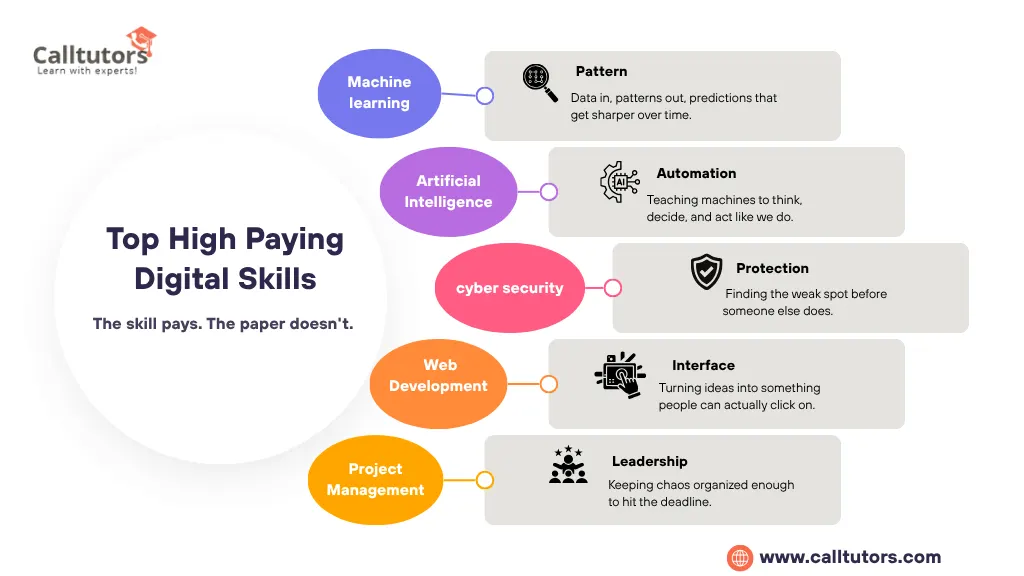
1. Machine Learning
Your bank flags a weird charge on your card within seconds of it happening. Spotify somehow keeps queuing songs you didn’t know you liked. Behind both things is machine learning doing its job without anyone noticing it.
Machine learning is what lets software look at piles of data find patterns that a human would probably miss and make predictions from what machine learning has learned.
Companies like machine learning because it helps them save money and make decisions faster decisions that used to take a time and a lot of people.
The people who build these systems are able to automate work catch fraud before it happens and predict where a market is going to move.
To get started in machine learning, you’ll need a good grip on statistics, comfort writing code, and enough Python know-how to build real things.
You can also use R if you like it better than Python.
Machine Learner Engineer Pay in the US –
| Experience level | Estimated Annual Pay (USD) |
| Entry-Level (0–2 years) | $114,000 to $189,000 |
| Mid-Level (3–5 years) | $131,000 to $206,000 |
| Senior-Level (6–10 years) | $171,000 to $273,000 |
| Lead/Principal (10+ years) | Lead/Principal (10+ years) |
2. Artificial Intelligence
AI is the whole machine — systems built to reason, adapt, and act in ways that start to resemble human judgment, at least in narrow situations.
It’s already sitting inside hospital diagnostics, fraud detection at banks, warehouse routing, and customer service chats that don’t feel like talking to a wall anymore. People working in AI aren’t only writing code all day — they’re figuring out how to automate the tedious parts of a business and solve problems that used to eat up entire teams for weeks.
As companies keep throwing budget at this, the people who can actually build and maintain these systems are in short supply relative to demand.
A Few Courses Worth Looking Into-
- Microsoft AI Engineer
- Professional Certificate in AI and Machine Learning
- Applied Agentic AI Course
- Applied Generative AI Specialization
Artificial Intelligence Engineer Pay in the US –
| Experience level | Estimated Annual Pay (USD) |
| Entry-Level (0–2 yrs) | $96,000 to $178,000 |
| Mid-Level / AI-ML Engineer (3–5 yrs) | $146,000 to $222,000 |
| Senior-Level (6–9 yrs) | $140,000 to $208,000 |
| Lead/Principal (10+ yrs) | $158,000 to $255,000 |
A couple of honest caveats worth mentioning: Glassdoor’s numbers shift depending on exact job title (AI Engineer vs. AI/ML Engineer vs. Artificial Intelligence Engineer all show slightly different ranges), and other sources like BuiltIn and Levels.fyi report higher figures because their data leans toward more senior, Big Tech-heavy respondents. So treat these as a realistic starting point, not gospel — your actual number will depend heavily on city, industry, and company size.
3. Software Engineering
Someone wrote the code that keeps your banking app from crashing every time you check your balance. And right now, someone else is probably fixing a bug in that same code.
The job is less about typing code and more about solving problems without creating three new ones in the process. Engineers lean on Git for tracking changes, Docker for packaging software, and Kubernetes when things need to scale past what one server can handle — usually written in Python, Java, JavaScript, or Go.
Cloud computing keeps reshaping this field every couple of years, but the core need — people who can build reliable systems — hasn’t gone anywhere.
Software Engineer Pay in the US –
| Experience level | Estimated Annual Pay (USD) |
| Entry-Level (0–2 yrs) | Around $127,600 |
| Mid-Level (3–5 yrs) | Around $150,000 |
| Senior-Level (6–9 yrs) | close to $209,000 |
| Lead/Principal (10+ yrs) | $190,000 to $258,000+ |
Want to explore more project ideas? Read our more articles: https://www.calltutors.com/blog/category/project-ideas
4. Web Development
A website that looks gorgeous but takes eight seconds to load is basically useless. Web development is where design instinct meets actual engineering — building things that look right, run fast, and don’t leak user data along the way.
HTML, CSS, and JavaScript are still the foundation everyone starts with. From there, people branch into React, Node.js, or Angular depending on what they’re building, and pick up a working understanding of SEO and site performance because a beautiful site nobody can find on Google isn’t doing much for anyone’s business.
Web Development Engineer Pay in the US –
| Experience level | Estimated Annual Pay (USD) |
| Entry-Level (0–2 yrs) | $77,000 – $90,000 |
| Mid-Level (3–5 yrs): | $90,000 – $110,000 |
| Senior-Level (6–9 yrs) | $110,000 – $130,000 |
| Lead/Principal (10+ yrs): | $130,000 – $160,000+ |
Learn the basics, then just build. Clone a site you admire. Make an ugly portfolio page and redo it three months later once you’re less embarrassed by it. That cycle, repeated enough times, is basically the entire learning curve.
5. Project Management
Somebody has to keep a dozen moving parts from colliding — budget, timeline, a client who keeps changing their mind, a developer who’s out sick during launch week. That’s the project manager, and it’s a role that rewards calm under pressure almost as much as it rewards spreadsheets.
Most project managers live inside tools like Jira, Trello, Asana, or Monday.com. Since nearly every industry runs on projects in some form — construction, healthcare, IT, you name it — this skill travels well across fields.
Project Management Engineer Pay in the US –
| Experience level | Estimated Annual Pay (USD) |
| Entry-Level (0–2 yrs) | $71,000 and $120,000 |
| Mid-Level (3–5 yrs) | $80,000 and $138,000 |
| Senior-Level (6–9 yrs) | $114,000 to $184,000 |
| Lead/Director (10+ yrs) | $150,000 and $180,000+ |
Worth noting: industry makes a real difference here. Fields like aerospace, energy, and financial services tend to pay noticeably more than average, while smaller companies and nonprofits often sit at the lower end. Location matters too — PMs in cities like New York typically out-earn the national average.
How to actually get in: Start small. Volunteer to run a tiny project at work or in a community group, even if it’s just organizing a fundraiser. Learn the tools as you go rather than studying them in a vacuum. The instincts sharpen fast once you’re actually accountable for something.
6. Cybersecurity
Somebody has to think like an attacker before an actual attacker shows up. That’s cybersecurity in a sentence — spotting the weak spot in a system before someone with bad intentions finds it first.
This field asks for a real grasp of how networks and operating systems work under the hood, plus a certain kind of paranoia that keeps you reading about new threats instead of assuming you’ve already learned enough. Certifications like CompTIA Security+ or CEH help prove you’re not just guessing.
Cybersecurity Engineer Pay in the US –
| Experience level | Estimated Annual Pay (USD) |
| Entry-Level (0–2 yrs): | $131,000 – $145,000 |
| Mid-Level (3–5 yrs) | $145,000 – $170,000 |
| Senior-Level (6–9 yrs) | $170,000 – $200,000 |
| Lead/Principal | $200,000 – $250,000+ |
Start with networking fundamentals — how data actually moves and where it can be intercepted. Then dig into encryption, ethical hacking, and risk assessment through hands-on labs rather than textbooks alone. This field punishes people who stop learning, so treat that as part of the job description, not an inconvenience.
Which high paying digital skills Actually Fits You
Nobody needs all nine of these. Trying to learn all of them at once is a pretty reliable way to master none of them.
If you like solving abstract puzzles and don’t mind math, machine learning or AI is probably a better fit than content writing. If you’d rather write a sentence that gets someone to click “buy” than debug a neural network at midnight, copywriting or digital marketing makes more sense. There’s no prestige ranking here worth taking seriously — the person earning six figures doing SEO isn’t worse off than the one doing machine learning. They’re just solving a different kind of problem.
Pick the one that doesn’t feel like homework, and give it more than a weekend before deciding it’s not working.
Frequently Asked Questions
1.What exactly counts as a “high-paying digital skill”?
Broadly, any technical or creative skill that companies are actively hiring for and paying well because the supply of people who can actually do it hasn’t caught up with demand yet.
2. Which one should a total beginner start with?
Digital marketing, content writing, and data analysis tend to have the gentlest learning curves and the most free resources available, which makes them reasonable starting points before branching into something more technical like machine learning.
3.How long does this actually take?
There’s no universal timeline. Some people land their first paid gig in a few months of consistent, daily practice; others take a year while juggling a full-time job. The pace matters less than not quitting three weeks in.